
Greek vs Roman Nose: Key Differences
Someone in the comments called your nose Greek, someone else said Roman, and both sounded sure. The Greek vs Roman nose question comes down to one line: the bridge of your nose seen from the side. One photo can answer it in a couple of minutes.
Written by Mia Hartley6 min readUpdated
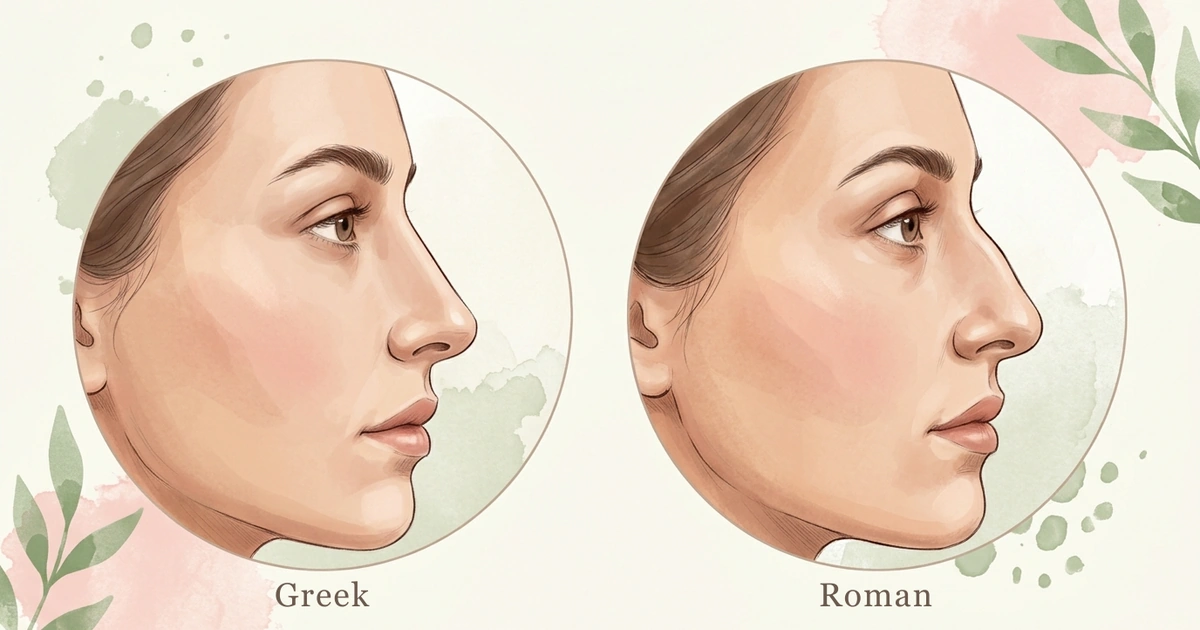
The name comes from ancient Greek statues. Seen from the side, their noses run straight down from the forehead, with almost no dip between the eyes. That is the classic Greek profile.
Real faces almost always have a clearer dip there, and that’s normal. So today, in a Greek nose vs Roman nose comparison, Greek simply means a straight bridge below that dip.
The bridge is what tells a Greek vs Roman nose apart. From the side, a Greek nose goes in a straight line from between the eyes to the tip. A Roman nose curves outward on the way down, often with a bump. Both tips point forward, though a Roman tip can dip a little. From the front, the two often look the same.
What Is a Greek Nose?
The Greek nose shape has a bridge that stays straight from top to tip when you look from the side. The bridge is the hard ridge down the middle of your nose. On a Greek nose it has no bump and no dip, and the tip points forward, not up or down.
It’s also called a Grecian nose or a straight nose. The name is only about the bridge, so the width and the tip don’t change it. A straight bridge with a rounded tip is still Greek. The tip just gets its own name, as Types of Noses explains.
What Is a Greek Nose? What Counts and What Doesn’t
Roman Nose vs Greek Nose: Side by Side
The Roman nose shape differs from the Greek one mostly at the bridge. The table shows the other differences. You need a side view for every row except the last two.
| Feature | Greek nose | Roman nose |
|---|---|---|
| Bridge from the side | Straight from top to tip | Curves outward, often with a bump |
| Dip between the eyes | Shallow, so the bridge starts high | Usually deeper, so the curve stands out |
| Tip | Points forward | Points forward or dips a little |
| Ruler on a side photo | Touches the bridge all the way down | Leaves a gap where the bridge curves |
| From the front | Looks straight | Often looks straight too |
| Also called | Grecian or straight nose | Aquiline nose, in most guides |
For most noses, the first row decides it: the bridge from the side. The tip only matters when it turns sharply down. Then a curved nose is closer to a hawk nose than a Roman one.
Also note the front view. A curve only shows from the side, so a mirror or a front photo can’t tell the two apart.
How to Tell if You Have a Greek or Roman Nose
One true side photo answers it for most noses. Hold a pen or a ruler along the bridge on your screen. If the bridge touches it all the way down, it’s Greek. If the bridge curves away from it, it’s Roman. What Is a Roman Nose? walks through this check step by step, and How to Choose a Photo shows how to take the photo.
The hard part is a nose in between, and that’s common. When people post their profile on Reddit and ask “Greek or Roman?”, the same nose often gets both answers. Most of the mix-ups come from these three cases.
A slight curve along the whole bridge. If there’s a thin gap under the ruler from top to bottom, the nose is Roman, even if the curve is small. Charts draw Roman noses with a big arch, so a gentle curve often gets called Greek by mistake.
One small bump on a straight bridge. Charts don’t agree here. Some call any bump Roman, and others call it a straight nose with a bump. Both are fair. Saying “mostly straight, with one small bump” is clearer than either name.
A straight bridge below a deep dip. This one is Greek. The deep dip between your eyes makes the top of the bridge stick out, so the nose can look curved at first glance. Start the ruler just below the dip, on the bridge itself, not on your forehead.
Is a Greek Nose Better Than a Roman Nose?
No. Neither shape is better. The Greek nose got its good reputation from ancient statues, and statues were carved to look perfect, not to look like real people.
Real noses don’t follow the rules in beauty guides either. Researchers measured the noses of healthy adults in two groups and compared them with the published beauty standards. On average, the real noses missed many of them. The straight statue nose was an artist’s choice, not a rule for real faces.
So if someone called your nose Roman like it was a bad thing, they only described a curve. What matters is how your nose fits the rest of your face, and What Nose Shape Suits My Face? shows how to check that. If you’d still like a straighter bridge, What Is a Roman Nose? lists your options, from makeup to surgery.
How NoseChic Helps You Compare Greek and Roman
Still not sure which name fits? Try both shapes on your own face. NoseChic has a Greek style, which shows a straighter bridge, and a Roman style, which shows a more curved one. Both work with a side photo, so use the one from your ruler check.
Make a Greek simulation first. It's ready in seconds. Then tap Try another style and pick Roman, so both use the same photo. Drag the Before and After slider on each and look only at the bridge.
The version that changes your nose the least is the one closest to the shape you already have. If Greek barely changes it, your bridge is close to straight. If Roman barely changes it, your nose curves more than you thought. These are pictures to compare, not a measurement or a surgical result.
Frequently Asked Questions
Is a Greek nose the same as a straight nose?
Mostly, yes. “Straight” describes only the bridge. “Greek” usually also means the tip points forward. So if your bridge is straight but your tip clearly turns up or down, you still have a straight nose. Most charts just add a second name for the tip, like upturned or drooping.
Is a Greek nose rare?
Nobody really knows. Numbers online go from about 3% to 20 to 30% of people, and they can’t all be right. The best-known count of nose shapes only used photos and artworks from Europe and Israel, so it can’t tell you how common a straight bridge is anywhere else. The same is true for Roman noses.
Do Greek people have Greek noses?
Not necessarily. The name describes the line of the nose from the side, not where someone’s family is from. People in Greece have straight, curved and bumpy bridges like people everywhere, and Roman noses aren’t only found in Italy. Anyone, from any background, can have either shape.
Sources and further reading
- A comparison of aesthetic proportions between the Oriental and Caucasian nose (Clinical Otolaryngology & Allied Sciences, via PubMed)
- Numerical survey of the different shapes of the human nose (The Journal of Craniofacial Surgery, via PubMed)
See your new nose in seconds
Download NoseChic, try nose job simulation on your own photo, and find the nose that feels right.